
 Martal
 Technology
 Education and training
 Web Development and UI / UX
 Healthcare/Medical
 Logistics and Supply Chain
 Information Technology
 Insuretech and Financial Services
 Marketplaces
 Software Development
 E-commerce and retail
 AI and Machine Learning
 Energy and Solar
 Manufacturing
 Security and Surveillance
 Digital Marketing Agency
 Transportation
 MSP
MSP
 Telecom
 B2B SaaS
 Cybersecurity
 HR tech
 Fintech
 Cleantech
 Consulting
10 Follow-Up Email Best Practices for B2B Sales Success in 2026
Major Takeaways: Follow-Up Email Best Practices
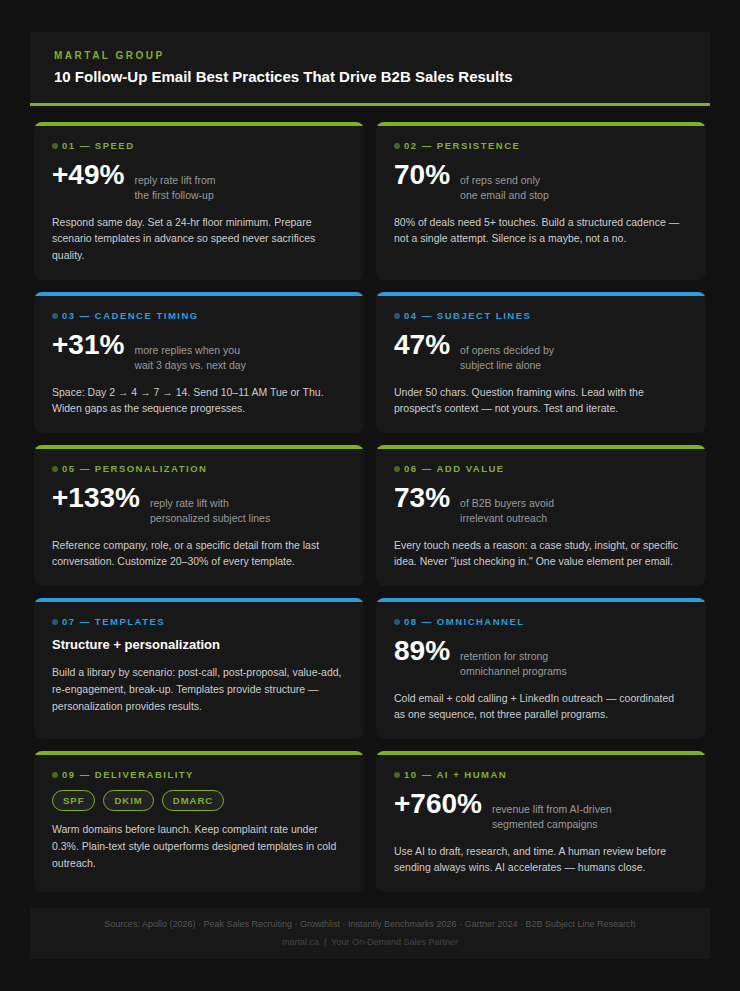
The first follow-up email alone can boost reply rates by as much as 49%, but only if it arrives while the prospect’s attention is still on the conversation. Respond the same day on warm interactions. Set a 24-hour floor as your minimum standard for all follow-ups.
80% of sales require five or more follow-ups to close, yet 70% of reps send only one email and never follow up again (1). The gap between what deals require and what reps actually do is where pipeline quietly dies. A structured cadence — not a single touch — is the difference.
Waiting three days before the first follow-up produces a 31% increase in replies. Next-day follow-ups reduce replies by 11% (1). Start with 2–3 day gaps early in the sequence, then widen to 7–14 days as touches accumulate.
47% of recipients decide whether to open an email based solely on the subject line (4). Keep it under 50 characters, lead with the prospect’s context — not yours — and test question-framed subject lines, which consistently outperform statements.
Personalized subject lines produce a 46% open rate versus 35% for generic alternatives, a 31% lift. Reply rates jump from 3% to 7% with personalization, a 133% increase (5). Reference the prospect’s company, role, or a specific detail from your last conversation — not just a first-name token.
“Just checking in” is the most common and least effective follow-up format in B2B sales. Gartner’s survey of B2B buyers found that 73% actively avoid suppliers who send irrelevant outreach (6). Add one genuinely useful element at every touch — a case study, a data point, a specific idea — or don’t send it.
Templates ensure consistency and speed. They fail when treated as scripts. Customize at least 20–30% of any template before sending — the structure stays consistent, the specifics must be earned. Build a library by scenario: post-call, post-proposal, value-add, re-engagement, break-up.
60% of clients never respond to a proposal unless followed up. Send the first proposal follow-up within 2–3 days of sending, reiterate the two or three benefits most relevant to what the prospect flagged on the call, and propose a specific next step — don’t leave the decision open-ended.
A coordinated omnichannel sequence — cold email, cold calling, and LinkedIn outreach working together — consistently outperforms email alone. Companies with strong omnichannel outreach strategies achieve 89% customer retention versus 33% for those with weak strategies (8). Email anchors the sequence; phone and LinkedIn add the human layer.
Campaigns with 4–7 emails in a sequence achieve three times the response rate of campaigns with only 1–3 emails (9). But beyond three or four follow-ups, reply rates decline and spam complaints increase sharply (10). Match sequence length to audience tolerance and content quality — not persistence alone.
Introduction
B2B sales aren’t won on the first contact, the fortune is in the follow-up. Email remains the channel most B2B buyers prefer for ongoing sales communication, and yet most teams leave significant pipeline on the table through poor follow-up habits, inconsistent timing, and messages that say nothing new.
We’ve seen this pattern repeatedly across Martal’s outbound campaigns. A prospect shows genuine interest after a cold call or demo, then goes quiet. What happens in the next 72 hours and the two weeks after that often determines whether that opportunity closes or quietly disappears.
This guide draws on Martal’s experience running outbound campaigns across 50+ B2B verticals, alongside current data from email performance research, to give you a practical follow-up framework you can implement immediately.
You’ll find ten best practices, each backed by data and grounded in what actually works in the field: when to follow up, how many times, what to say, and how to structure emails that get read and replied to. We’ve also included templates, subject line guidance, and real cadence examples — so you leave with more than theory.
If your team is losing deals to silence, this is where to start.
10 Follow-Up Email Best Practices That Drive B2B Sales Results
Most deals don’t close on the first contact. They close because someone followed up — the right way, at the right time, with the right message.
The problem is that most follow-up emails are either too generic to earn a reply, sent too quickly or too late to land well, or abandoned entirely after a single attempt. Research shows that70% of reps send only one email to a prospect and move on (1), leaving the majority of pipeline opportunities untouched.
The ten best practices below are drawn from current email performance data and from what we see consistently across Martal’s outbound campaigns. They cover the full follow-up picture: timing, structure, subject lines, personalization, value, templates, omnichannel coordination, deliverability, and the role AI now plays. Work through them in order, or jump to the section most relevant to where your cadence is breaking down.
1. Speed Is Critical: Follow Up Within Hours, Not Days
The first follow-up email can increase reply rates by up to 49%, directly impacting your pipeline and quota attainment.
Source: Apollo
Timing starts before your first follow-up — it starts with how quickly you respond to initial interest.
Leads contacted shortly after expressing interest are far more likely to convert than those reached hours or days later. The window closes fast: once a prospect’s attention moves on, re-capturing it requires significantly more effort. When a prospect fills out a demo request, downloads a resource, or replies to a cold email, they’re in an active evaluation mode.
In practice, Martal’s Sales Executives prepare follow-up email templates in advance — post-call recaps, proposal acknowledgments, demo summaries — so they can be personalized and sent within minutes of the interaction, not the following morning. For inbound leads, the goal is a response within the same business hour where possible.
What to do:
- Set CRM or platform alerts to notify you the moment a prospect takes an action
- Prepare scenario-based templates in advance (post-call, post-demo, post-proposal) so speed doesn’t sacrifice quality
- Aim for same-day follow-up on all warm interactions; within 24 hours as a minimum floor
- If you can’t follow up personally, use scheduled sends — but ensure the email is personalized before it goes
2. Persistence Pays: Don’t Stop at One Email
80% of sales require five or more follow-ups to close, but 70% of reps stop after just one email.
Source: Peak Sales Recruiting
The majority of B2B deals require multiple touches before a prospect responds. Most reps never reach that threshold.
80% of sales require five or more follow-ups to close, yet 70% of reps send only one email to a prospect and never follow up again (1). That gap is where pipeline goes to die — and where disciplined teams gain a significant competitive advantage.
Persistence, done correctly, isn’t harassment. It’s structured patience. Each follow-up gives the prospect another window to respond at a moment when they’re available and receptive. The second follow-up alone can boost the chances of a response by up to 50% (2).
We’ve seen this play out in extended Martal engagements. For Southern Code, a software development firm, nurture cycles ran as long as 10 months before prospects converted — sustaining one closed deal per month throughout. The deals were there. What converted them was consistent, value-adding follow-up over time, not a single well-crafted email.
A sample 5-touch cadence (cold outbound):
- Day 0: Initial outreach — intro, ICP-relevant hook, single CTA
- Day 2: First follow-up — reference prior email, add one new piece of context or value
- Day 5: Second follow-up — share a relevant case study, insight, or specific question
- Day 10: Third follow-up — new angle, address a likely objection preemptively
- Day 21: Fourth follow-up — polite “break-up” email; leave the door open
How many follow-up emails is too many?” is a question asked across sales forums, and there’s no single universal answer. The honest answer: it depends on lead temperature, industry, and deal size. For cold outbound, most sequences cap at 4–6 touches over 3–4 weeks before moving to a long-term nurture. For warm prospects who’ve shown genuine interest — attended a demo, downloaded a resource, replied once — follow up indefinitely until you get a clear yes or no. Silence is a maybe.
Campaigns with 4–7 emails in a sequence get three times the response rate compared to those with only 1–3 emails (9). But there’s a ceiling. Beyond three follow-ups, reply rates decline as spam complaints and unsubscribes increase — with campaigns reaching four or more emails seeing a significant spike in both (10). The practical implication: a well-structured 4–6 touch sequence with genuinely varied content at each step is the sweet spot for most B2B cold outbound. Longer sequences need tighter targeting and higher personalization to justify the additional touches — not just persistence for its own sake.
Keep each email purposeful. Vary the message and the value offered at each touch — don’t repeat the same ask five times with slightly different wording.
3. Cadence Timing: Space Emails Strategically
Sending a follow-up email within 48 hours of the first touch can boost open rates by up to 18%
Source: SQ Magazine
Persistence and timing are separate variables. You can follow up five times and still underperform if the spacing is wrong.
Following up the very next day consistently produces fewer responses than waiting 2–3 days. Early in a sequence, shorter gaps work because the conversation is fresh. As the sequence progresses, spacing should widen — both to avoid inbox fatigue and to catch the prospect at a different moment in their week.
Recommended follow-up spacing:
- 1st follow-up: 2 days after initial contact
- 2nd follow-up: 4 days after the first
- 3rd follow-up: 7 days after the second
- 4th follow-up: 10–14 days after the third
- 5th follow-up and beyond: 2–3 weeks between touches
If a prospect doesn’t reply to your initial email, how soon should you follow up, and what should that follow-up look like?”. This one of the most searched questions in sales.
The data is clear here. Waiting three days before your first follow-up results in a 31% increase in replies. Next-day follow-ups reduce replies by 11%. The optimal window between a cold email and first follow-up is 2–5 days (1). For warm leads — someone who requested a demo or responded positively — tighten that to 24 hours. The first follow-up should do three things: briefly re-anchor the conversation, add one new piece of value or context that wasn’t in the original email, and close with a single, easy CTA. Never just resend the original.
Day-of-week and time-of-day matter too. Mid-morning sends (10–11 AM in the prospect’s timezone) consistently outperform noon sends, when inboxes compete with lunch. Follow-up emails sent within 48 hours of the first touch see an 18% boost in open rates (3). Tuesday and Thursday are generally the strongest days for B2B email engagement — Friday afternoons and Monday mornings are the weakest.
Adjust cadence based on lead temperature. A warm inbound lead who requested a demo warrants tighter early spacing (Days 1, 3, 7). A cold outbound prospect with no prior interaction benefits from slightly more breathing room between touches.
4. Subject Lines Decide Whether Your Email Gets Read
The subject line alone influences 47% of email recipients in deciding whether to open an email.
Source: Sales So
This is the most consistently overlooked element in follow-up email strategy — and one of the highest-leverage.
47% of email recipients decide whether to open an email based solely on the subject line (4). A follow-up email with strong content and a weak subject line will be invisible. Most “just following up” subject lines trigger exactly that outcome.
Personalized subject lines produce a 46% open rate compared to 35% for generic ones, a 31% lift. Reply rates jump from 3% with no personalization to 7% with personalization, a 133% increase (5).
What works in B2B follow-up subject lines:
- Question framing: “Still worth a conversation, [Name]?” — questions outperform statements by consistently generating higher open rates
- Specificity: Reference the company, the conversation, or the specific pain point — not a generic pitch
- Short length: Subject lines of 2–4 words or under 50 characters outperform longer options; they render fully on mobile and don’t get cut off
- Avoid hype terms: Words like “URGENT,” “last chance,” or “quick question” (when it’s not actually a quick question) erode trust fast
Examples of weak vs. strong follow-up subject lines:
Weak
Stronger
Following up
Quick question about [Company]’s pipeline
Just checking in
Re: our conversation Tuesday
Any updates?
Thought this might help, [Name]
Touching base
One idea for [Company Name]
Test subject lines with your actual audience. What works for a SaaS VP of Sales may differ from what lands with a manufacturing operations director.
5. Personalize Every Message — Not Just the Greeting
Personalized subject lines drive a 133% higher reply rate compared to non-personalized ones.
Source: Mailmend
Generic follow-up emails are immediately recognizable and immediately ignored.
Personalized subject lines produce a 133% increase in reply rates compared to non-personalized alternatives (5). But effective personalization goes beyond inserting a first name. It means referencing something specific to the prospect’s situation, role, company, or prior conversation — details that prove the email was written for them, not at them.
What meaningful personalization looks like:
- Reference a specific challenge the prospect mentioned on a call
- Acknowledge a relevant company event — a funding round, a product launch, a LinkedIn post by their CEO
- Tailor the value prop to their industry or role, not just their job title
- Mention a relevant case study from their vertical or a comparable company size
When starting from a template (which is efficient and encouraged), customize at least 20–30% of the content before sending. The template provides structure; the personalization provides reason to respond.
One pattern that works well in outbound: research one recent, specific, publicly available fact about the prospect’s company and open with it. Not in a stalker-y way — in a “we pay attention to our buyers” way. A line like “Saw that [Company] just expanded into the APAC market — a lot of our clients in that phase find outbound pipeline generation becomes critical” signals relevance before you’ve said anything about your solution.
6. Add Value at Every Touch — Eliminate “Just Checking In”
73% of B2B buyers actively avoid suppliers who send irrelevant outreach, making targeted investment in outreach essential.
Source: Gartner
Every follow-up should give the prospect a reason to read it beyond the existence of a prior email.
The “just checking in” follow-up is the most common and least effective format in B2B sales. It asks for something — a reply, a decision, an update — without offering anything in return. Gartner’s survey of B2B buyers found that 73% actively avoid suppliers who send irrelevant outreach (6). Relevance isn’t optional.
Ways to add value in each follow-up:
- Share a relevant industry insight, research finding, or data point
- Include a short case study from a client in a similar vertical or situation
- Answer a question the prospect raised but you didn’t fully address in the last exchange
- Offer a brief audit, quick observation, or specific idea relevant to their business
- Link to a resource (guide, calculator, benchmark report) that addresses a problem they mentioned
Martal’s outbound sequences are built around this principle — each touch in a campaign has a designated value theme: the first introduces the value prop, the second shares proof, the third offers an insight, the fourth proposes a next step. The prospect is receiving value at every stage, which keeps engagement alive even when they’re not yet ready to reply.
What should I say in the follow-up email?” is another top question with most reps are actually stuck on when their sequence stalls.
The answer isn’t a script. It’s a principle: every follow-up needs a reason to exist beyond the ask. If you can’t answer “what does the prospect get from reading this email?” before you hit send, rewrite it. The most effective mid-sequence follow-ups give the prospect one of the following: a relevant case study from a comparable company, a specific data point tied to a challenge they mentioned, an answer to a question that came up on the call but wasn’t fully resolved, or a concrete idea for their business that shows you’ve thought about them specifically. That’s it. One thing. Keep it short. End with a question that’s easy to answer.
Frame CTAs the same way: instead of “Can we schedule a call to discuss next steps?” try “I have two ideas for [Company]’s outbound pipeline that I’d like to share — worth 15 minutes?”
7. Use Templates as Structure, Not Scripts
Personalized templates drive 5x to 10x higher response rates by triggering relevance in B2B outreach.
Source: DemandZEN
Templates are a productivity tool, not a shortcut to skip personalization.
Used correctly, they ensure consistency, reduce ramp time for new reps, and guarantee that every follow-up includes the structural elements that drive replies: a reference to the prior interaction, a value-add, and a clear CTA. Used lazily, they produce exactly the kind of mass-produced copy that kills response rates.
The practical standard: customize at least 20–30% of any template before sending. The structural bones stay consistent — the specifics must be earned.
Templates worth building into your library:
- Post-initial-outreach follow-up (2 days after first email, no response)
- Post-demo / post-call recap (same day or next morning — covered in detail below)
- Post-proposal follow-up (2–3 days after proposal sent)
- Value-add follow-up (shares insight or case study, no direct ask)
- Break-up email (final touch, 4–6 weeks in, politely closes the sequence)
Keep templates concise — 3 to 5 sentences for mid-sequence follow-ups, slightly longer for post-demo recaps where a summary is genuinely useful. Every word should earn its place.
8. Coordinate Across Channels — Email Is One Part of the Sequence
Strong omnichannel strategies lead to 89% retention, while weak ones retain just 33%.
Source: Instantly
Email is the backbone of most B2B follow-up cadences. It shouldn’t be the only channel.
Companies with strong omnichannel outreach strategies achieve 89% customer retention, while those with weak strategies retain just 33% (8). In a sales context, that translates directly to deal conversion. Prospects who receive a coordinated sequence — email, followed by a relevant LinkedIn touchpoint, followed by a phone call when interest signals fire — convert at meaningfully higher rates than those who receive email alone.
What this looks like in practice:
- Email anchors the sequence and carries the most detailed value content
- LinkedIn adds a human layer — a connection request, a relevant comment, a direct message after engagement signals
- Phone is deployed strategically — after a prospect opens multiple emails without replying, or after a proposal has been sitting for more than a week
The key word is coordinated. These aren’t three parallel outreach tracks — they’re one sequence with channel-appropriate touches. A cold call that references the email you sent Tuesday feels like a logical continuation. A cold call that appears to have no connection to your other outreach feels random.
At Martal, this coordinated omnichannel approach is how our Sales Executives run campaigns across cold email, cold calling, and LinkedIn lead generation — not as separate programs but as a single, orchestrated sequence designed around the prospect’s buying signals.
9. Protect Your Deliverability — Emails That Don’t Arrive Can’t Convert
A complaint rate above 0.3% can tank inbox placement, making deliverability a top priority.
Source: Mailpro
All the personalization and timing discipline in the world won’t help if your emails are landing in spam.
Deliverability is now a strategic priority: Gmail, Yahoo, and increasingly Microsoft require SPF, DKIM, and DMARC configuration for bulk senders, and complaint rates above 0.3% will tank inbox placement (7). This isn’t a technical footnote — it’s a front-line sales issue. Poor domain health quietly kills reply rates and is often the last thing teams diagnose.
Core deliverability practices for follow-up sequences:
- Domain warm-up: New sending domains need 2–4 weeks of gradual volume increases before running full sequences. A platform like Warmy automates the warmup layer that sits on top of SPF/DKIM/DMARC and keeps the sending domain in good standing.
- Authentication: SPF, DKIM, and DMARC should be configured before any campaign sends
- Volume pacing: Ramp sending volume weekly rather than sending at full volume from day one
- List hygiene: Verify email addresses before sending; high bounce rates damage sender reputation fast
- Plain-text style: Emails that look like 1:1 messages (minimal HTML, no heavy formatting, no image-heavy layouts) consistently outperform designed templates in cold outreach
Martal’s platform manages domain warm-up, sending rotation, and bounce monitoring automatically — ensuring that by the time follow-up sequences go live, the sending infrastructure is healthy and inbox placement is protected.
10. Use AI to Improve Follow-Ups — Not to Remove the Human From Them
AI-driven email personalization boosts click-through rates and can deliver up to 760% higher revenue from segmented campaigns.
Source: Mailmend
AI has become a genuine productivity lever in follow-up email execution. It can accelerate drafting, improve personalization at scale, optimize send timing, and surface intent signals that tell you who to prioritize. What it can’t do is replace the judgment, context, and relationship awareness that make a follow-up email feel like it came from a human who actually paid attention.
Teams using AI to personalize email content see double-digit lifts in click-through rates and up to 760% higher revenue from segmented campaigns (5). Those results come from AI enhancing human-led outreach — not from automated sequences running without oversight.
At Martal, our AI Sales Platform handles the research-intensive and repetitive elements of follow-up execution: building enriched prospect lists, generating personalized draft sequences based on ICP data, monitoring intent signals, and flagging accounts that are showing buying behavior. Our Sales Executives then refine, personalize further, and handle the actual relationship-building and qualification. The AI accelerates the work. The human closes it.
For in-house teams, the practical rule is simple: use AI to draft and structure, then edit before sending. A follow-up email reviewed by a human who knows the prospect will always outperform one sent automatically with no review.
How to Write a Follow-Up Email: A Step-by-Step Format
The best follow-up emails share a consistent structure. Understanding that structure makes it easier to write quickly, personalize meaningfully, and avoid the common mistakes — the blank check-in, the wall of text, the vague CTA — that kill response rates.
Here’s the anatomy of a follow-up email that works:
Step 1: Write the Subject Line Last
Start with the body and work backward. Your subject line should reflect the most compelling element of what you’ve written — not a generic “Following up” that telegraphs nothing.
Keep it under 50 characters. Use a question, a specific reference, or the prospect’s company name. Avoid urgency language, excessive punctuation, and anything that reads like a marketing blast.
Step 2: Open With Context, Not Pleasantries
Skip “Hope you’re doing well.” Open with a direct reference to why you’re writing — and make it specific.
“Following up on the proposal I sent Tuesday for [Company]’s outbound pilot” is better than “I wanted to reach out again.” The first sentence should immediately anchor the prospect in the conversation. They receive dozens of emails a day. Give them the context they need to keep reading in the first line.
Step 3: Add One New Piece of Value
This is the element most follow-ups skip — and the reason most don’t get replies.
Don’t just remind the prospect you exist. Give them something: a relevant case study, a useful data point, an answer to a question they raised, a specific idea for their business. One well-chosen value-add turns a reminder into a reason to respond.
If you’re mid-sequence and running low on fresh material, a question works: “Curious whether budget timing was the main factor, or if there were other considerations — happy to revisit the scope if that helps.” A genuine question invites a reply in a way that “any updates?” does not.
Step 4: Write a Specific, Low-Friction CTA
Every follow-up email needs one clear next step — and only one.
Asking for too many things in a single email (a reply, a call, a decision, a referral) dilutes the ask. Pick one. Make it easy to say yes to. Specific time offers work better than open-ended requests:
“Would Thursday at 2 PM work for a 20-minute call?” outperforms “Let me know if you’d like to connect.”
If the deal is early stage, a yes/no question often works better than a meeting request: “Is outbound pipeline still a priority for Q3, or has the focus shifted?” It’s easy to answer and surfaces information that helps you calibrate the next touch.
Step 5: Keep It Short
Mid-sequence follow-up emails should be 3–5 sentences. Post-demo or post-call recaps can run slightly longer because a summary is genuinely useful — but even those should be scannable, not dense.
A follow-up that takes 90 seconds to read will consistently outperform one that takes three minutes. Busy decision-makers skim. Write for the skim.
Step 6: Review Before Sending
Before hitting send: confirm the name and company are correct (copy-paste errors on these are immediately trust-eroding), check that the CTA is clear and singular, and read the subject line one more time. Thirty seconds of review protects weeks of relationship-building.
Follow-Up Email After a Sales Call: Templates and Best Practices
The follow-up email you send after a sales call is one of the highest-value emails in your entire sequence. The prospect has already engaged. The conversation happened. What you do in the next few hours determines whether that momentum carries forward or dissipates.
The goal of a post-call follow-up isn’t to recap everything that was said. It’s to confirm the key points, demonstrate that you listened, advance the deal to the next step, and give the prospect something useful to take into any internal conversation they’re having about your solution.
What to Include in a Post-Call Follow-Up Email
- A brief recap of what was discussed — two or three bullets covering the core challenges or goals the prospect raised, framed in their language, not yours
- One or two next-step items — what you agreed to do, what they agreed to do, and by when
- A relevant piece of supporting material — a case study, a one-pager, a link to your ROI calculator, or an answer to a specific question that came up on the call
- A clear CTA — the single most important action you want them to take before you speak again (book the next call, review the proposal, loop in their technical lead)
Post-Call Follow-Up Email Template
Here is a clean, adaptable template for a follow-up email after a sales call. Customize the bracketed elements before sending.
Subject: Re: Our call — next steps for [Company Name]
Hi [First Name],
Thanks for your time today — the conversation gave me a clear picture of where [Company Name] is focused heading into [timeframe].
A few things I took away:
- [Key challenge or goal #1 they mentioned, in their words]
- [Key challenge or goal #2, if relevant]
- [Any specific constraint or timeline they flagged]
As discussed, I’ll [your committed next step — e.g., “send over the proposal by Thursday” / “connect you with a case study from a similar company in [industry]”]. On your end, you mentioned [their committed next step, if applicable].
[Optional: Include one sentence delivering the value you promised — a relevant case study, a link to a resource, or an answer to a question raised on the call.]
I’ll [follow up / send the proposal / reach out] on [specific day]. If anything changes on your end before then, feel free to reply here.
[Sign-off]
Timing and Length
Send post-call follow-ups within two hours of the call whenever possible — while the conversation is still fresh for both parties. If the call ran long or you need time to pull together supporting materials, same-day is the floor.
Keep the email short. Three to six sentences, plus the bullet recap, is the right range. The purpose isn’t to re-pitch — it’s to confirm, advance, and leave a professional impression. A post-call email that takes four minutes to read often undermines the rapport built on the call itself.
A Note on Tone
Match the register of the call. If the conversation was direct and businesslike, keep the email crisp. If the prospect was warm and candid, a slightly more conversational close is appropriate. The follow-up should feel like a continuation of the conversation you just had — not a reset into formal sales-speak.
Follow-Up Email Examples: Templates for Every Stage
The following templates cover the most common B2B follow-up scenarios. Each is designed to be customized — the structure is consistent, the content must be made specific before sending. Modify at least 20–30% of each template to reflect the prospect’s actual situation.
Template 1: First Follow-Up After No Response (Day 2)
Subject: Quick question about [Company Name]’s [relevant goal or challenge]
Hi [First Name],
I reached out [earlier this week / last Tuesday] about [brief, specific description of what you offered or discussed].
I wanted to follow up with one thing I should have included: [one relevant data point, case study reference, or insight specific to their industry or role].
Worth a quick conversation? I’m happy to keep it to 15 minutes.
[Sign-off]
Template 2: Value-Add Follow-Up (Day 5)
Subject: Something relevant for [Company Name]
Hi [First Name],
Sharing this because it’s directly relevant to what you mentioned about [specific challenge].
[One sentence describing the resource or insight — e.g., “We recently ran a campaign for a [industry] company facing the same bottleneck — here’s what changed their reply rates in 30 days.”] [Include link or attach case study.]
Happy to walk through how this applies to [Company Name] specifically if it’s useful.
[Sign-off]
How should I write the second follow-up email?” is a question that repeatedly appears in various sales forms.
By the second follow-up, the prospect has seen your name twice and hasn’t replied. The mistake most reps make here is sending a slightly reworded version of the first email. That signals nothing has changed — and nothing new gives them no new reason to respond. The second follow-up should feel like a different angle entirely: a different value point, a different format (a question instead of a statement, or a case study instead of a pitch), and ideally a different subject line that doesn’t just say “Re: Re: Re:.” Template 3 below is specifically designed for this scenario.
Template 3: Proposal Follow-Up (2–3 Days After Sending)
Subject: Re: [Company Name] proposal — any questions?
Hi [First Name],
Following up on the proposal I sent [day]. I want to make sure you have everything you need to review it thoroughly.
The two things most relevant to what you flagged on our call:
- [Key benefit #1 tailored to their stated priority]
- [Key benefit #2 or timeline / implementation detail they cared about]
If it would help to walk through any section together, I’m happy to schedule 30 minutes. Otherwise, let me know if you have questions and I’ll get back to you quickly.
[Sign-off]
Template 4: Re-Engagement After Silence (Day 21+)
Subject: Should I close your file, [First Name]?
Hi [First Name],
I’ve reached out a few times over the past few weeks and haven’t heard back — which usually means one of two things: either the timing isn’t right, or I missed the mark on relevance.
Either way, no pressure. If [challenge or goal you originally addressed] becomes a priority again, I’m here. And if there’s a better person on your team to be talking to, I’m happy to redirect.
If this isn’t the right time, just say the word and I’ll step back.
[Sign-off]
Template 5: Break-Up Email (Final Touch)
Subject: Closing the loop, [First Name]
Hi [First Name],
I’ve tried to connect a few times and haven’t been able to reach you — I’ll assume the timing isn’t right and won’t keep following up.
If anything changes on your end, [your contact info / link to book a call] is here when you need it.
Thanks for your time either way.
[Sign-off]
Turn Best Practices Into Pipeline
Following up well isn’t complicated. It’s consistent.
The teams that convert the most prospects aren’t necessarily sending better first emails — they’re the ones who respond faster, follow up more times, personalize more specifically, and build enough trust across enough touches that when a prospect is ready to move, they already know who to call.
The ten practices in this guide form a framework you can implement without a complete overhaul of your sales process. Start with the gaps that are costing you the most: subject lines if your open rates are low, cadence timing if replies are dropping off after the first touch, value-add content if prospects are opening but not responding.
If the challenge is capacity — your team doesn’t have the bandwidth to run disciplined follow-up cadences across hundreds of active prospects — that’s a different problem, and it’s one we solve directly.
At Martal, our onshore Sales Executives run coordinated omnichannel campaigns that combine cold email, cold calling, and LinkedIn outreach as a single, sequenced program — not three disconnected channels. Every prospect receives a structured follow-up cadence built around their ICP, their industry, and the specific buying signals they’re showing. Our AI Sales Platform handles the data enrichment, sequence generation, and intent monitoring. Our SEs handle the judgment, the personalization, and the qualification.
The result is a follow-up engine that works at scale without sacrificing the human quality that actually earns responses.
If your pipeline is stalling between first contact and first meeting, book a consultation with our team. We’ll walk you through what a qualified follow-up cadence looks like for your market and show you what Martal’s model can deliver.
The fortune is in the follow-up. Let’s make sure yours is working.
References
- Peak Sales Recruiting.com
- Stripo
- SQ Magazine
- Sales So
- Mailmend
- Gartner
- Mailpro
- Instantly
- GrowthList
- The Digital Bloom
FAQs: Follow-Up Email Best Practices
How many follow-up emails should I send before giving up?
For cold outbound, most well-structured B2B sequences run 4–6 touches over 3–4 weeks before transitioning to a long-term nurture. For warm prospects who have shown genuine interest — attended a demo, replied once, or downloaded content — follow up until you get a clear answer. The common mistake is treating silence as rejection. It rarely is. Most prospects aren’t ignoring you deliberately; they’re busy, they got pulled into something else, or your email landed at the wrong moment. A structured cadence with varied messaging ensures you give the relationship enough chances to convert without burning the contact.
How long should I wait before sending a follow-up email?
The optimal window for your first follow-up is 2–3 business days after the initial email — long enough to respect the prospect’s time, short enough that the conversation is still fresh. Waiting three days before a first follow-up produces a 31% increase in replies compared to following up the next day, which reduces replies by 11%. Peaksalesrecruiting For subsequent follow-ups, gradually widen the gaps: 4 days, then 7, then 10–14. For warm inbound leads who’ve explicitly requested information, tighten the timeline — same day or within 24 hours is appropriate.
What do you say in a follow-up email when there’s no response?
Don’t repeat what you said in the original email. Instead, add one new piece of value — a relevant case study, a specific data point, an answer to a likely objection, or a concrete idea tied to their business. Reference the prior touchpoint briefly to anchor context, then move to the new material. Close with a single, specific question that’s easy to answer with one sentence. Avoid “just checking in,” “touching base,” or “circling back” — these signal you have nothing new to say, which makes ignoring the email feel justified.
Is it okay to follow up if someone hasn’t opened my email at all?
Yes. Open tracking is unreliable — a significant portion of “unopened” emails are actually read but not tracked due to image blocking or preview pane reading. Don’t use open data alone to decide whether to follow up. If your cadence says it’s time to send the next touch, send it. Use the follow-up as an opportunity to reframe the subject line and opening sentence — which effectively gives you a second chance at a first impression.
How do I follow up without seeming pushy or annoying?
The answer is in the content, not the frequency. A follow-up that offers something genuinely useful — a relevant insight, a case study from a comparable company, a specific idea for the prospect’s business — doesn’t feel pushy because it’s not asking for something without giving something first. Space your emails appropriately, vary your messaging at every touch, and always give the prospect an easy out. A line like “If the timing isn’t right, just let me know and I’ll circle back in a few months” actually increases reply rates because it removes pressure and signals respect.
What’s the best subject line for a follow-up email?
The most effective follow-up subject lines are specific, short, and framed around the prospect’s context — not yours. Question-framed subject lines consistently outperform statements. Personalized subject lines produce a 46% open rate versus 35% for generic alternatives. Belkins Avoid “Following up,” “Checking in,” or “Quick question” when it isn’t actually a quick question. Better options: “Re: [Company]’s pipeline”, “One idea for [Company Name]”, or “Still worth a conversation, [First Name]?” Keep subject lines under 50 characters so they render fully on mobile — where the majority of B2B emails are now first opened.