
 Martal
 Technology
 Education and training
 Web Development and UI / UX
 Healthcare/Medical
 Logistics and Supply Chain
 Information Technology
 Insuretech and Financial Services
 Marketplaces
 Software Development
 E-commerce and retail
 AI and Machine Learning
 Energy and Solar
 Manufacturing
 Security and Surveillance
 Digital Marketing Agency
 Transportation
 MSP
MSP
 Telecom
 B2B SaaS
 Cybersecurity
 HR tech
 Fintech
 Cleantech
 Consulting
What Is B2B Sales? The Definitive Guide to Strategies, Challenges, and Trends
Major Takeaways: What Is B2B Sales
Business-to-business selling involves long cycles, multiple stakeholders, and tailored solutions—unlike B2C, it rewards business value, not impulse.
Reps with real B2B experience excel at high-stakes outreach, ROI-led selling, and steering complex buying committees across industries.
The strongest teams coordinate cold calling, LinkedIn, and email in sequence—buyers now expect multiple, connected touchpoints before they ever engage.
AI has gone mainstream in selling—87% of sales organizations now use it for prospecting, lead scoring, personalization, and outreach, freeing reps to focus on relationships.
93% of buyers engage more readily with reps who personalize their communication. Generic pitches lose to context-rich, account-based messaging.
Teams with shared ICPs, integrated messaging, and closed-loop reporting generate higher-quality leads and shorten sales cycles.
A growing share of B2B companies use Sales-as-a-Service models to enter new markets and fill pipeline gaps without hiring, training, and ramping an in-house team.
With Millennials and Gen Z now the majority of business buyers, digital self-service, fast responses, and consumer-grade CX have become genuine sales differentiators.
Introduction
B2B sales—business-to-business sales—isn’t really about selling products to other companies. It’s about solving business problems, building long-term relationships, and guiding buyers through a complex, multi-stakeholder decision. And the way that decision gets made has changed fast. Gartner’s widely cited benchmark—that 80% of B2B sales interactions would shift to digital channels—has essentially arrived (6), and nearly half of all B2B purchases now happen online (5). The playbook that worked a few years ago is already showing its age.
If you’re a CMO, CRO, VP of Sales or Marketing, or an SDR leader, you feel the pressure to keep your team ahead of that curve. Buyers are better informed and more skeptical, sales cycles have stretched longer, and AI is rewriting parts of the process in real time. We get it—running outbound at scale is what we do every day at Martal Group. We built this guide by pairing what we see in the field with current industry research, so you get both the operator’s view and the data behind it. The goal is simple: help you cut through generic advice and focus on what actually moves pipeline.
Here’s what we’ll cover:
- B2B Sales 101: What business-to-business sales entails—and how it differs from B2C.
- B2B Sales Experience: What “B2B sales experience” really means for teams and careers.
- The B2B Sales Process: The core stages every deal moves through, from prospecting to close.
- Sales Methodologies: The frameworks—consultative, solution, SPIN, Challenger—that shape how reps sell.
- Winning Strategies: The practices—omnichannel outreach, personalization, alignment—that drive results.
- Major Challenges & Bottlenecks: Long cycles, buying committees, buyer hesitancy, and how to clear each one.
- Trends to Watch: Digital-first selling, AI and automation, shifting buyer demographics, and more.
What Is B2B Sales?
49% of B2B spending is now conducted online, signaling a significant shift toward digital-first purchasing behavior.
Reference Source: Think With Google
At its core, B2B (business-to-business) sales means selling products or services from one business to another. Your customer is an organization, not an individual consumer—which means higher stakes, bigger price tags, longer relationships, and far more complex decisions than you’d see in B2C. As HubSpot frames it, B2B sales exist to solve a business problem or help an employee do their job better, while B2C sales meet a personal need (1). Put simply, B2B sales is about delivering business value—software that streamlines operations, equipment that lifts output, or services (like outsourced sales) that help a company grow.
One thing we see often: the deals that close fastest aren’t the ones with the flashiest pitch—they’re the ones where the seller tied the solution to a number the buyer already cared about. In B2B, value has to be provable, not just persuasive.
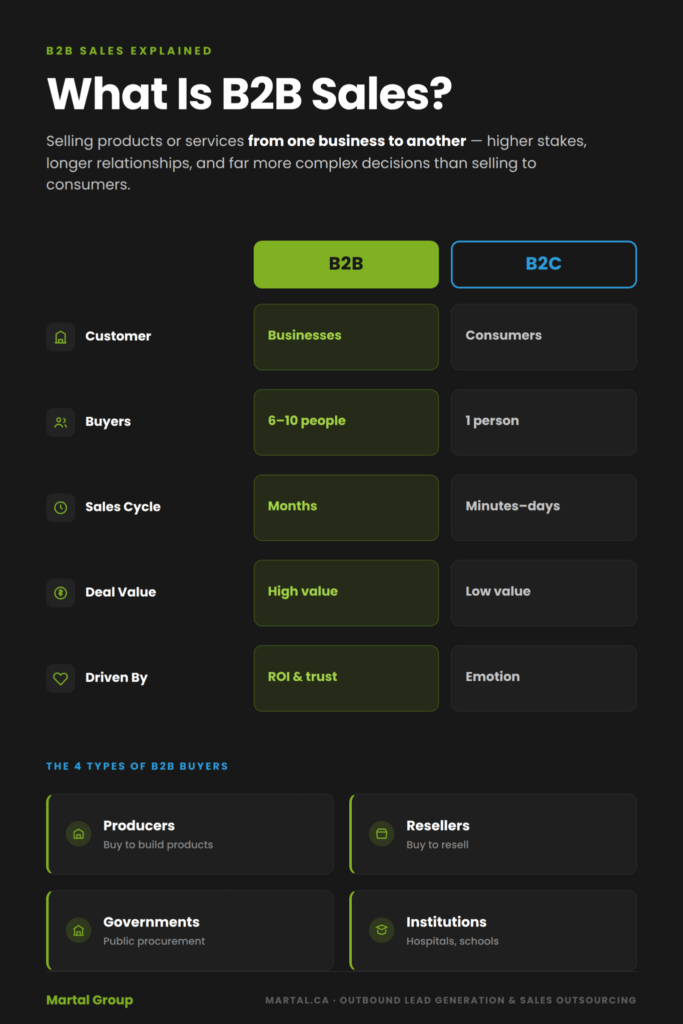
How is B2B sales different from B2C? In a word: complexity. B2B deals typically involve larger contracts, multiple stakeholders, and longer sales cycles. B2C sales are usually one-to-one, with a single consumer making a quick purchase (think buying a pair of shoes online). Here are the key differences:
Aspect
B2B Sales (Business-to-Business)
B2C Sales (Business-to-Consumer)
Customer
Businesses and organizations (companies, government, non-profits).
Individual consumers or households.
Decision Process
Complex, multi-layered—often involves multiple stakeholders (buying committees, managers, executives) and a long review/approval cycle.
Simple, personal—usually one decision-maker with a short decision time.
Relationship Focus
Long-term partnerships—relationship-building, account management, repeat orders and contracts.
Transactional—often one-off purchases; brand loyalty exists but transactions are quicker.
Sales Cycle
Longer and consultative—months or more, with demos, negotiations, and custom proposals.
Shorter and impulse-driven—minutes or days, based on need or desire.
Value & Volume
High value, low volume—fewer deals, each worth more (e.g. a $100k software contract).
Low value, high volume—many smaller transactions (e.g. a $50 retail sale).
Marketing & Sales
Focus on education and ROI—detailed content, demos, ROI calculators. Aligning sales & marketing is crucial to address complex buyer needs (10).
Focus on emotion and convenience—advertising, branding, and quick benefits.
Examples
Enterprise software sold to a corporation; a manufacturer selling components to another manufacturer; a sales agency providing B2B lead generation services to a tech startup.
Selling clothes or electronics to shoppers; a gym selling memberships; streaming services selling subscriptions.
As the table shows, B2B sales demands a strategic, consultative approach, while B2C leans transactional. B2B sellers act as advisors—understanding the client’s business, tailoring solutions, and often helping build the internal business case. And because everyone from end users to the C-suite can influence a purchase, reps have to speak to several concerns at once: technical fit for IT, ROI for finance, reliability for operations.
It’s also worth separating B2B direct sales from channel sales. In a direct model, your own team—or an outsourced team acting as your team—sells straight to the end buyer, owning every touch from first outreach to close. In a channel model, you sell through resellers or distributors who sell onward. Most outbound-led growth motions are direct: the relationship, the messaging, and the qualification all stay in your hands.
Who are B2B customers? They fall into four broad groups: producers, resellers, governments, and institutions (2). Producers buy goods or services to build their own products (a carmaker buying steel). Resellers—wholesalers and distributors—buy to resell. Governments, from local to federal, purchase everything from office supplies to infrastructure (often called B2G). Institutions like non-profits, hospitals, and universities buy to operate. Each demands a different approach: selling to a government means strict procurement and compliance, while selling to a startup may move faster but carry more risk.
What Does B2B Sales Experience Mean?
It takes an average of 18 or more calls to reach a single B2B prospect, highlighting the persistence needed in outbound sales.
Reference Source: Thinkific
You’ve seen it on job postings and LinkedIn profiles: “B2B sales experience required.” But what does that actually mean? At its simplest, B2B sales experience is a background in selling to organizations rather than consumers. In practice, it means a sales executive has learned to navigate the realities of selling to a business—managing long sales cycles, pitching to senior executives, handling complex RFPs, and coordinating across buying committees.
If you’ve done it, you’ve built strong consultative selling skills: you know how to surface a company’s pain points and position your solution against them. You’re comfortable with B2B prospecting and cold outreach to busy professionals, you can qualify leads on business fit, and you can write proposals that speak to ROI. You also know the grind it takes—often 8, 12, or more touchpoints to close, when many reps need 18+ calls just to reach a single prospect (8).
For sales leaders, hiring for B2B experience matters more than most job descriptions admit. A rep from a pure retail or B2C background may not be ready for the consultative, multi-stakeholder reality of B2B. A seasoned B2B rep, by contrast, already speaks the language of business value, handles objections like “budget approval” and “integration complexity” without flinching, and brings a network worth leveraging. One pattern we’d flag when evaluating reps: look less at how many deals they’ve closed and more at how they handled the deals that stalled. Keeping a multi-stakeholder deal alive through a quiet stretch is the clearest signal of real B2B experience.
With the definition and the skill set covered, let’s get into the core of this guide—the process every B2B deal follows, the methodologies behind how reps sell, the strategies that win, the challenges that stall deals, and the trends reshaping the field.
The B2B Sales Process: How a Deal Moves From Prospect to Close
Gartner finds B2B buyers spend just 17% of their total purchasing time meeting with potential suppliers—so every stage of your process has to earn its place.
Reference Source: Gartner
Most B2B deals follow the same underlying arc, even when the timeline and the players change. Knowing the B2B sales process stage by stage helps you spot where deals slow down and where reps should spend their energy. Here’s the sequence at a glance:
- Prospecting — identify and reach best-fit accounts
- Qualification — confirm fit, need, and authority
- Discovery — diagnose the real problem
- Presentation / Demo — connect the solution to that problem
- Proposal & Negotiation — align on scope, price, and terms
- Close & Handoff — sign, then set up a clean start
Here’s what each stage actually involves—and where we see them break down.
1. Prospecting
Pipeline begins here: building a targeted list and opening conversations through B2B prospecting across cold email, cold calling, and LinkedIn. What matters at this stage isn’t volume—it’s fit. A tightly defined ICP and a real reason to reach out (a trigger event, a relevant pain) beat a bigger list every time. One thing we see often: teams that blast wide spend the next three stages cleaning up poor-fit conversations.
2. Qualification
Not every interested prospect is a real opportunity. Qualification confirms the account matches your ICP and that the contact has genuine need and the authority to act. We qualify on authority and need first—budget and timeline surface naturally once those two are clear. Get this stage wrong and the cost compounds downstream: reps burn discovery and demo hours on deals that were never going to move.
Disciplined qualification is what separates a busy pipeline from a productive one. In one 13-month engagement with a manufacturing AI/ML company, tight qualification turned 362 leads into 153 SQLs—a 42% lead-to-SQL rate, well above typical B2B benchmarks, plus 84 booked meetings. View the AI and machine learning use case.
3. Discovery
Discovery is a diagnosis, not a pitch. The goal is to understand the prospect’s situation well enough to know whether—and how—you can help. Strong reps listen more than they talk, ask about the cost of the status quo, and map who else will weigh in. The deals that close cleanest are the ones where discovery surfaced every stakeholder early, before the demo.
4. Presentation / Demo
Now you connect the solution to the problem you uncovered. The mistake we see most: a generic, feature-by-feature walkthrough. A demo that lands speaks to the specific outcomes each stakeholder cares about—ROI for finance, integration and security for IT, day-to-day workflow for the end users in the room.
5. Proposal & Negotiation
Here you formalize scope, pricing, and terms. Momentum is fragile at this point, so keep it moving: set clear next steps, anticipate procurement and legal review, and arm your internal champion with what they need to defend the purchase to finance. Deals rarely die here from a hard “no”—they die from drift.
6. Close & Handoff
Signing isn’t the finish line. A clean handoff to onboarding or account management protects the relationship you just built and sets up renewals, upsells, and referrals. The strongest B2B teams treat the close as the start of the next opportunity, not the end of this one.
Knowing the process is one thing; how a rep sells through it is another. That’s where sales methodologies come in.
How to Improve B2B Sales: Key Strategies
93% of B2B buyers are more likely to engage with a sales professional who provides personalized communications.
Reference Source: LinkedIn State of Sales
Strong B2B sales performance comes down to pairing time-tested tactics with newer approaches. If you’re trying to improve how your team sells—and ultimately increase B2B sales—these are the strategies we’d prioritize:
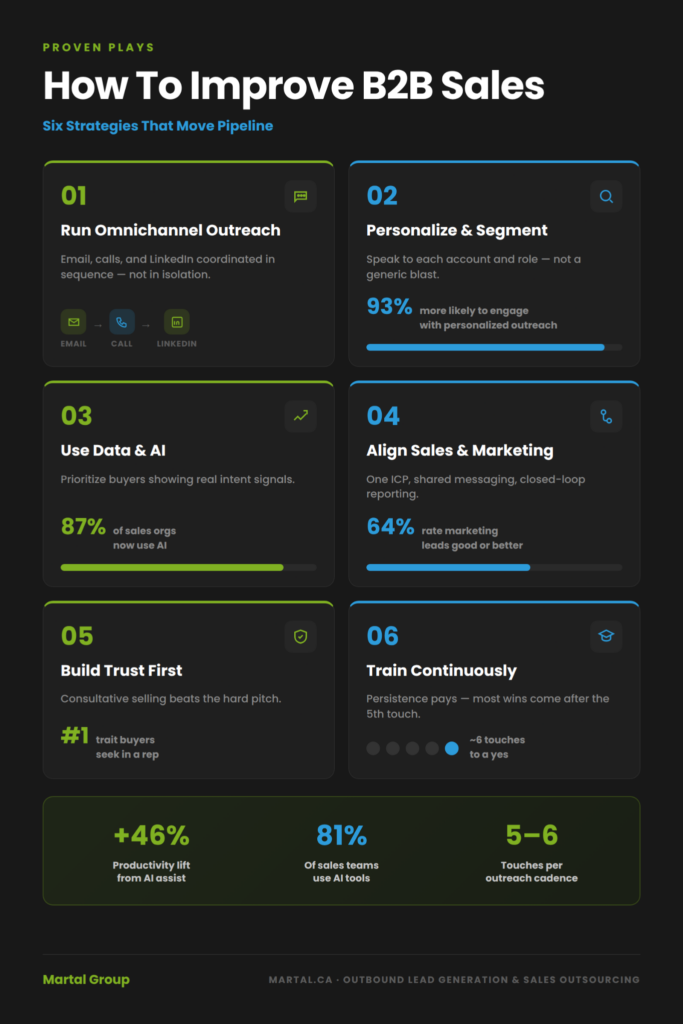
- Embrace Omnichannel Outreach. B2B buyers want you to meet them across multiple channels—cold calls, email, LinkedIn, webinars, events—used in concert, not isolation. Most B2B buyers now prefer a mix of in-person, remote, and self-service interactions across their journey (3). A prospect might attend your webinar, take a Zoom call with your rep, then expect an in-person demo for final stakeholders. Coordinate your sales development representatives and account executives so campaigns run across phone, email, and LinkedIn together: email a case study, follow up with a call, then connect on LinkedIn with a relevant post. An omnichannel marketing approach keeps prospects engaged and prevents channel fatigue—when one door closes, another opens.
This is exactly how we run campaigns. For Afton Tickets, an events-services company, a coordinated omnichannel push produced 97 SQLs and 5 closed deals in 9 months—and a single one of those deals covered the entire cost of the engagement. - Hyper-Personalize and Segment (Account-Based Selling). The one-size-fits-all sales pitch is dead. To stand out, show you understand the buyer’s business—the heart of Account-Based Marketing/Selling (ABM). Identify your highest-value target accounts, research each deeply, and tailor your outreach strategies to the specific industry, company, and individual. Reference their goals and pain points; prepare demos for their use case. Buyers are 93% more likely to engage with a rep who personalizes communication (10). Even small touches—citing recent company news or a prospect’s LinkedIn post—lift reply rates. And segment by role: a VP of Finance cares about ROI, a CTO about integration and security. Tailor your value proposition to each stakeholder. ABM means more upfront work, but the payoff is higher engagement and trust.
- Leverage Data and Intelligence (Work Smarter with AI). Modern B2B sales is as much science as art. High-performing teams use data—and increasingly AI—at every step. Track activity and conversion in a solid CRM and sales-engagement platform, and prioritize sales leads showing buying signals, like repeat visits to your pricing page. AI-driven prospecting tools can analyze thousands of signals to surface the best sales ready leads at the right moment. Gartner’s benchmark that 80% of B2B interactions would move to digital channels has arrived, and it projects that within a few years a large share of seller work could run through AI-powered interfaces (6). Practically, that means exploring lead generation tools that draft personalized outreach (with human review) or flag when a target account raises funding. Watch your conversion rates at each stage of the lead generation funnel, test what works, and let the data guide you.
- Align Sales and Marketing (One Revenue Team). Complex B2B deals need a seamless buyer journey, which means tight B2B sales and marketing alignment. Your marketing team and sales team should share one definition of a qualified lead, the same ICPs, and consistent messaging. Marketing runs lead nurturing that educates early-stage buyers; sales feeds back which messages land in real conversations. When it clicks, 64% of sales pros rate marketing leads as “excellent” or “good” (10), and deals close faster. Coordinate outbound campaigns—if marketing emails CFOs about an industry report, have reps follow up referencing it. To the buyer, there’s no “marketing” and “sales,” just your company.
- Focus on Relationships and Trust (Consultative Selling). For all the tech, B2B sales is still human. Invest in genuine relationships: listen more than you pitch, ask thoughtful questions, show industry knowledge. Provide value in every touch—an intro, a free analysis, a relevant case study. Aim to become a trusted advisor, because trust is the number one attribute buyers seek in a salesperson (10). Build it and prospects open up about internal hurdles, loop you into the B2B buying process, and stick with you when competitors circle. Consistency reinforces trust—send that email follow-up when you said you would—and don’t vanish after the sale. We’ve seen deals won not on features or price, but because the client trusted our team more.
- Commit to Continuous Training. The best sales orgs treat training as ongoing, not a one-off onboarding task. Coach regularly on product knowledge, industry shifts, and new techniques; role-play objections and discovery. Encourage reps to share what’s working—a new opening line, a sharper way to show ROI. We believe in this enough that we built Martal Academy to keep our SDRs current on outbound lead generation tactics. Sharp skills dull fast without practice; steady training keeps win rates up and teams adaptable.
Put these strategies to work and you’re positioned to win more in modern B2B. But execution isn’t easy—next, the challenges and bottlenecks that stall even strong teams, and how to clear them.
Common B2B Sales Bottlenecks and How to Fix Them
The average B2B buying group now runs 6 to 10 stakeholders, and enterprise deals can reach 17 or more, each one a chance for the deal to slow down.
Reference Source: Gartner
Every seasoned B2B sales leader knows selling to businesses comes with its share of headaches. Most of them cluster into a handful of recurring B2B sales bottlenecks. Here are the five we see most—and how to clear each:
- Long sales cycles and complex decision-making
- Buyer self-education and late engagement
- Cutting through the noise
- Economic pressure and deal stalling
- Compliance, privacy, and technical barriers
Long Sales Cycles & Complex Decision-Making
B2B deals can feel like a marathon. Instead of one decision-maker, you’re working buying committees and drawn-out approvals. The average group now runs 6 to 10 stakeholders (6), and enterprise committees can swell to 17 or more. More stakeholders mean more meetings, more evaluations, more consensus-building—and high-value deals can stretch 6, 12, even 18+ months. To navigate it, map every likely B2B decision-maker and their criteria, tailor information to each (a security audit for the CTO, an ROI analysis for the CFO), and find an internal champion who’ll advocate when you’re not in the room. Keep momentum by setting next steps at every meeting—long cycles usually go dark because the seller stopped project-managing the deal for the buyer.
We worked with Polygon—an IoT climate-control company expanding into the US—across a 24-month engagement, prospecting multi-stakeholder buying groups in construction, architecture, and property management to deliver 203 SQLs and 139 booked meetings.
Buyer Self-Education & Late Engagement
Buyers do a ton of homework before they ever talk to sales. By the time a prospect reaches your rep, they’ve often scoured your site, read reviews, and compared alternatives—85% have largely defined their requirements before contacting a sales rep (4). Many avoid sales until the last minute; Gartner has found roughly 75% would prefer a rep-free experience when possible (6). The risk: if they’ve misread something or anchored on a competitor, you’re on the back foot. So make sure the information buyers find on their own is accurate and compelling, and when you do engage, don’t steamroll what they “know.” Acknowledge their research—“I see you’ve been reviewing our docs—what have you found, and what can I clear up?”—then bring insight they couldn’t get alone: benchmarking data, a tailored ROI calc, a story of a similar company that solved the same problem.
Cutting Through the Noise
Getting a busy executive’s attention is hard. Inboxes overflow with cold emails, LinkedIn fills with pitches, and calls go to voicemail. The numbers are sobering: cold-call connect rates sit near 2%, it can take 18+ calls to reach one prospect, and 63% of salespeople say cold calling is the hardest part of the job (8). Breaking through takes skill and strategy. Sharpen your outbound sales technique: personalize heavily, use intriguing subject lines, and reference a real trigger (“Congrats on the funding round…”). Multi-channel touches help—an ignored email plus a thoughtful LinkedIn comment can warm the next attempt. Refine targeting over volume, and don’t quit early: many wins come after the 5th+ contact, so build cadences with at least 5–6 touches across channels.
Economic Pressure & Deal Stalling
Even a willing buyer can hit the brakes over budget, shifting priorities, or fear of a bad call. “No decision” is a real competitor: roughly 86% of B2B purchases stall at some point (4), and finance scrutiny is rising—in about 79% of purchases the CFO now has final sign-off (4). Counter it by building a strong business case early: quantify the cost of doing nothing, provide ROI projections and peer proof, and offer a pilot or staged rollout to lower perceived risk. Multi-thread the deal—don’t lean on one champion—and engage finance directly where you can. When a deal wobbles, get creative on structure, and keep communication honest so objections surface instead of turning into silence.
Compliance, Privacy & Technical Barriers
Legal and technical hurdles quietly derail deals. Privacy laws (GDPR, CCPA) and anti-spam rules shape how you source and contact leads—buying lead lists or emailing without proper opt-outs is a liability. Email deliverability is its own challenge; aggressive sending without warm-up and domain rotation lands you in spam. On the buyer’s side, security reviews, procurement, and legal redlines can add weeks. Get ahead of it: brief reps on lawful, respectful outreach, prepare security documentation in advance, pursue certifications like SOC 2 where relevant, and ask early, “What’s your vendor approval process, and who needs to be involved?” Handled well, this builds trust rather than friction—proving you’re easy and safe to do business with.
In short: B2B sales is hard by nature, but forewarned is forearmed. Map the stakeholders, personalize the outreach, demonstrate ROI, and clear the compliance path early—and you’ll move more deals than competitors who treat these bottlenecks as surprises.
Next, the trends reshaping how we sell and buy.
The Future of B2B Sales: Trends to Watch
AI adoption in B2B sales is now mainstream: 87% of sales organizations use AI for tasks like prospecting, forecasting, lead scoring, and drafting outreach.
Reference Source: Salesforce
B2B sales doesn’t look like it did even a few years ago. Technology, generational change, and tighter budgets keep reshaping how we sell and how buyers buy. These are the trends worth aligning with rather than fighting.
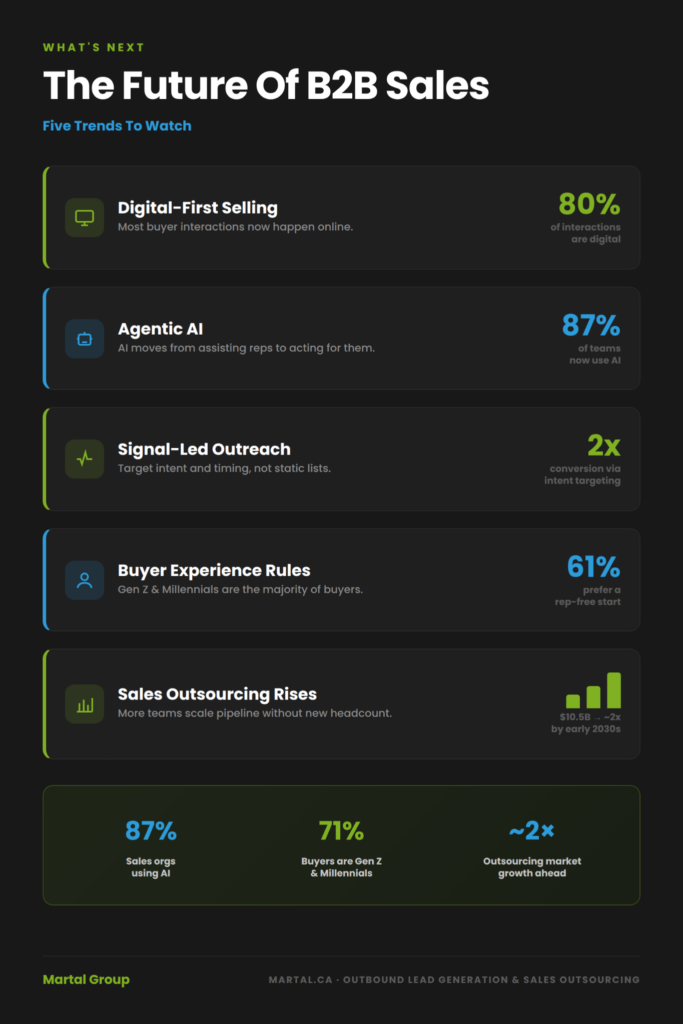
- Digital-First, Hybrid Selling Is the Default. Most buyer interactions have moved online for good. Gartner’s benchmark—80% of B2B sales interactions shifting to digital channels—has arrived (6), and even relationship-driven industries now close large deals over video and e-signature. Face-to-face isn’t dead; it’s one part of a broader hybrid cycle. A buyer might take a Zoom intro, an in-person technical demo, then weeks of async email and portal-based procurement. Reps have to sell well remotely—master virtual presentations, hold attention over web conferences, build rapport without a handshake—and invest in self-serve content (interactive demos, product tours, FAQs) buyers can access on their own. With Millennials and Gen Z now the majority of business buyers, self-service is the expectation, not a nice-to-have. Meet buyers where they are, respond fast, and reserve in-person time for the moments that need it.
- Agentic AI Moves From Assist to Action. If one theme defines B2B sales right now, it’s the shift from AI that assists reps to AI that acts for them. The last wave of tools drafted emails and summarized calls; the current wave runs multi-step work—surfacing high-intent accounts, enriching them, launching personalized outreach, and qualifying replies before a human steps in. McKinsey has estimated generative AI could unlock roughly $1 trillion in annual productivity across sales and marketing (7), and adoption has caught up to the hype—87% of sales organizations now use AI in some form (11). This isn’t about replacing salespeople. It’s about handing the repetitive first-touch and research work to AI SDR platforms and sales agents so reps spend their hours on relationships, strategy, and complex deals. The teams pulling ahead are the ones piloting these tools now—and cleaning up their data so the agents have something accurate to act on.
- Signal-Led, Data-Driven Outreach. The sharpest teams build targeting around real buying signals instead of spraying cold lists. They monitor who’s researching relevant topics, who visits the site, and which accounts just hit a trigger event—then time outreach to that moment (“We noticed teams in your space are exploring X—here’s how we help…”). Why cold-call a thousand companies blindly when data points you to the hundred showing intent? Internally, the same discipline shows up as tighter pipeline management, predictive deal scoring, and A/B-tested sequences. The cliché holds: in B2B sales, teams that act on data outperform teams that run on gut feel.
- Elevated Buyer Expectations (CX and Personalization). B2B buyers now expect the same experience they get as consumers on Amazon or Netflix. That means speed (answer fast, sign electronically, onboard without friction), personalization that continues after the sale (success check-ins, tailored updates), and authenticity—younger decision-makers prefer reps who admit “I don’t know, let me find out” over pushy know-it-alls. They lean on peer input and reviews, so strong customer-advocacy programs matter more than ever. They also expect to reach you on their channel of choice—email, phone, a shared Slack channel—as part of one connected, omnichannel experience. The sellers who win deliver a smooth, responsive, genuinely helpful process from first touch through renewal.
- Outsourcing and Fractional SDR Teams on the Rise. As B2B sales grows more complex, more companies are choosing to outsource sales and marketing or augment their team with fractional talent. Building an in-house engine is slow and costly, and not every org has the expertise. By outsourcing inside sales—appointment setting, lead generation, or full execution—companies plug into ready-made talent and infrastructure. The market reflects it: B2B sales outsourcing was valued at roughly $10.5 billion in 2024 and is projected to nearly double by the early 2030s (9). Hand in hand with this is the rise of Sales-as-a-Service—on-demand teams that enter new markets without the client hiring and training staff—and fractional sales leaders who work across multiple companies. The practical upside is agility: instead of spending six months hiring and ramping reps, you can engage an outsourced SDR team and start generating pipeline far sooner, often with specialized skills in cold calling or a target region built in. The likely future is hybrid: in-house teams working alongside outsourced ones, with leaders managing both.
We see this play out in fast-ramp engagements. For one transportation company with an AI freight platform, an outsourced omnichannel program delivered 122 SQLs and 108 booked meetings in just three months—the kind of speed that’s hard to hit by building a team from scratch. View the transportation case study.
These trends point one direction: B2B sales keeps getting more digital, more data-driven, more customer-centric, and more dynamic. The teams that adapt—new tools, sharper targeting, genuine attention to buyer experience—will pull ahead of those still doing it “the way we’ve always done it.”
How to Increase B2B Sales: Bringing It Together
The B2B sales outsourcing market was valued at roughly $10.5 billion in 2024 and is projected to nearly double by the early 2030s, a sign of how many companies now lean on outside teams to grow pipeline.
Reference Source: Verified Market Research
B2B sales is demanding, but it rewards the teams that adapt. We’ve covered what B2B sales is, how it differs from B2C, the process and methodologies behind it, the lead generation strategies worth deploying, the bottlenecks to clear, and the trends reshaping the field. The common thread is adaptability—the teams that win adopt new channels, new tools, and new approaches to meet buyers where they are.
The north star stays the same: the buyer’s experience and the buyer’s problem. Make it easy for the customer to see value and say “yes,” and any tactic or trend becomes easier to navigate. That might mean retraining your team, realigning with marketing, or investing in tooling—but the return shows up in revenue and competitive edge.
Accelerate Your B2B Sales Growth with Martal
If that sounds like a lot to juggle, it is. That’s where we come in. Martal Group’s omnichannel outbound solutions help B2B companies put these strategies into practice. We act as an extension of your team, coordinating cold calling, cold emailing, LinkedIn outreach, and appointment setting into a single omnichannel motion—part of our broader sales outsourcing model. The channels aren’t piecemeal; they run in concert so prospects get a consistent, professional experience at every touch. While your team closes, we fill the pipeline with qualified business leads using data-driven, intent-based targeting to reach the right buyers at the right time.
Skill is half the battle, which is why we keep our SDRs sharp through Martal Academy. Partner with us and you get a fractional sales team that’s already trained, AI-augmented, and fluent in consultative selling—ready to start generating pipeline fast. We’ve done this for companies from startups to global enterprises: in a nine-year partnership, we helped Clickworker generate $4.5M in recurring revenue at a 500% ROI, including Fortune 10 and Fortune 500 deals. And because our onshore teams operate across North America, Europe, and LATAM—in your buyers’ timezone and market context—your brand stays front and center in every conversation.
The track record speaks for itself: trusted by 2,000+ B2B brands across 50+ verticals over 16+ years, and ranked #1 in Lead Generation on Clutch. When we represent you to prospects, we are you—your values and voice carry through every interaction.
If you want to improve your B2B sales results—more qualified meetings, a new market, a shorter sales cycle—let’s talk. Book a consultation and we’ll map your goals to a concrete omnichannel plan. Scaling B2B sales is what we do best.
References
- HubSpot – “B2B vs. B2C Sales”
- Eqvista Blog
- Selling Power
- Corporate Visions
- Think With Google
- Gartner – Future of Sales
- SAP Future of Commerce
- Thinkific
- Verified Market Research
- LinkedIn State of Sales
- Salesforce
FAQs: What Is B2B Sales
What’s the difference between B2B and B2C sales?
B2B (business-to-business) sales means selling to organizations; B2C means selling to individual consumers. The practical difference is complexity. B2B deals carry larger price tags, involve multiple stakeholders—often a buying committee of 6 to 10 people—and run on longer, consultative sales cycles measured in months. B2C purchases are usually quick, single-decision, and emotion-driven. B2B leans on education and ROI (demos, business cases, references); B2C leans on convenience and brand. In short: B2B sells business value to a group, B2C sells personal value to a person.
What are the 4 types of B2B?
The four main types of B2B customers are producers, resellers, governments, and institutions. Producers buy goods or services to build their own products (a carmaker buying steel). Resellers—wholesalers and distributors—buy to resell. Governments, from local to federal, purchase through formal procurement (often called B2G). Institutions like hospitals, universities, and non-profits buy to operate. Each requires a different approach: government sales mean strict compliance and procurement, while selling to a startup can move faster but carry more risk.
Is B2B sales a good career — and what’s the catch?
Yes, B2B sales is a strong career: solid earning potential, transferable skills, and clear paths from SDR to Account Executive to sales leadership. The honest “catch” experienced reps will name: it’s demanding. Rejection is constant, cycles are long, and income often rides on hitting quota. The reps who thrive treat it as a craft—building consultative skill, resilience, and a real understanding of how businesses buy. If you like problem-solving, relationships, and measurable results, the upside far outweighs the grind.
Is B2B sales hard?
It can be. B2B sales is complex by nature—long cycles, multiple decision-makers, high rejection rates, and deals that stall for reasons outside your control. But that complexity is also why it’s rewarding and well-paid. Success comes down to persistence, process, and relationship-building: qualifying the right accounts, multi-threading across stakeholders, and adding genuine value at every touch. It’s challenging, but for skilled professionals it’s one of the more durable, lucrative careers in business.
How do I get into B2B sales with no experience?
The most common entry point is an SDR or BDR role—an outbound-focused job built to train new reps on prospecting, qualification, and outreach. To stand out without experience, learn the fundamentals (consultative selling, the sales process) and treat your job search like a sales process: research target companies, reach out to hiring managers directly, and show you can prospect. A simple portfolio—a target account list and a sample outreach sequence—often beats another certificate. From SDR, the path typically leads to Account Executive and beyond.
How can I improve my B2B sales?
Focus on a few high-leverage moves. Run omnichannel outreach—cold calling, email, and LinkedIn coordinated in sequence, not in isolation. Personalize by account and role instead of blasting generic messages. Qualify hard on authority and need so reps spend time on real opportunities. Align sales and marketing around one ICP and shared messaging. And measure conversion at each stage so you can fix what’s leaking. If building that engine in-house is slow, a partner like Martal can run the omnichannel motion for you—handling outreach while your team closes.